
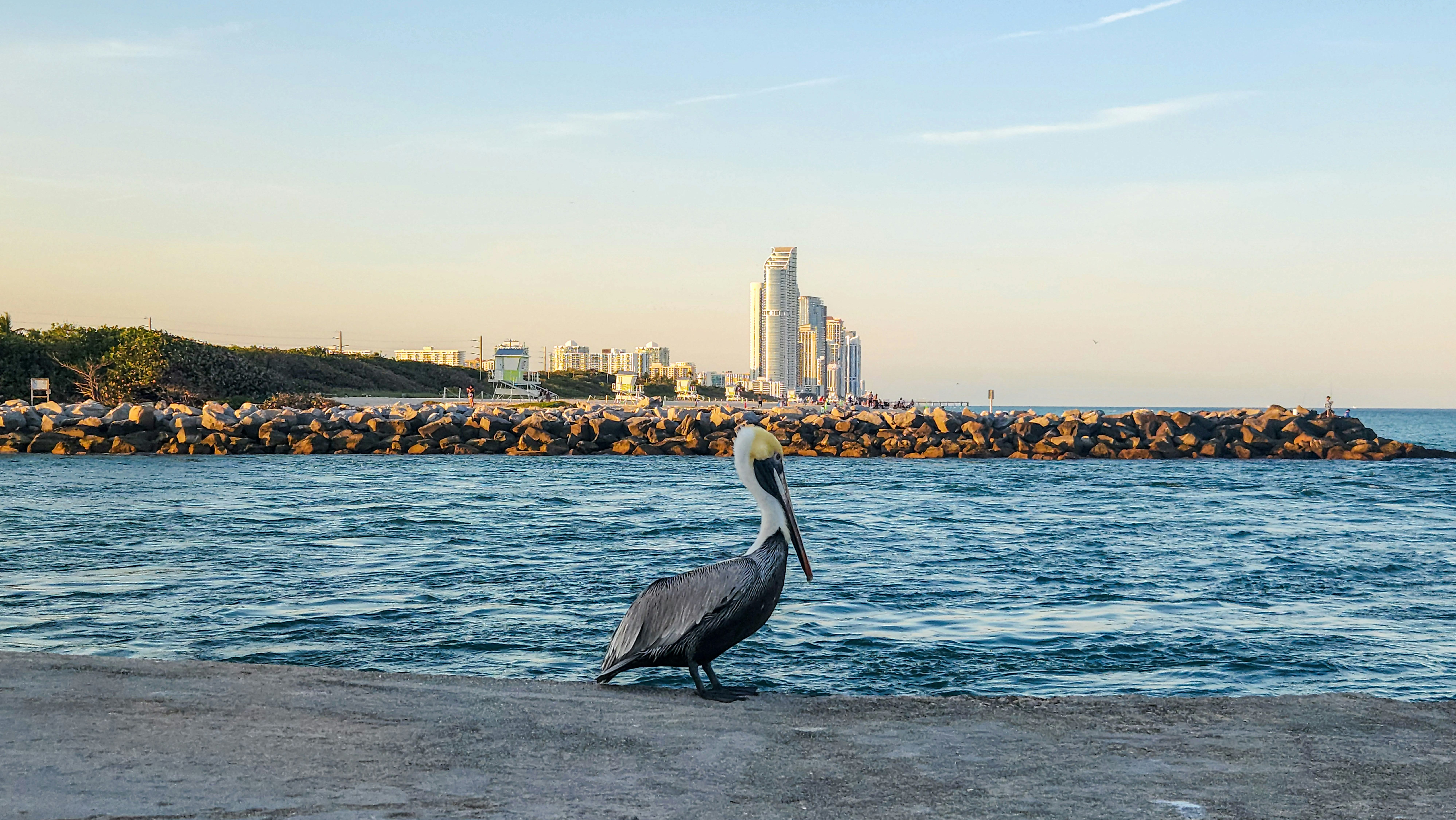
Photo by Zoshua Colah on Unsplash
i.

The broken promise of a river snakes,
morphs into marshes and lakes,
turns green in the shade of the trees.
Cattails stick out in curiosity —
some yellow, some droop.
Birds perch upon its surface
and peck at their own reflections.
The brackwater fills the veins
of mangroves, fuels the heartbeat
of a cracking earth.

We cut the river into canals, then
took a machete to the slash pines,
the cypresses, the ferns, the saltwort, and such —
then we swung the machete
through the neck
of a heron who stood in the way.

ii.

The border of the county,
the fraying ends of streets
I wished to tie together
to make a ribbon, my
Miami a gift in a paper
box.

There, between drowsy suburbs
and favelas, the children would come
out and play in the streets,
as the cars were slow and infrequent
enough that it was safe to be
a little boy carrying a football
under a curled arm and wishing
to speak in a language the others
would understand.

iii.

Memories of the white city:
LEDs strung around palm trees
in stead of fading stars, cardboard
homes with empty pools, the faraway
grumbling of trains and planes.
Faceless neighbors beyond the picket fence,
a too-big window: the best place to see
nothing at all.

Humid air, the ghost of the marsh
replaced by golf courses and houses
cold to the touch. Sometimes I’d imagine
it vengeful, and sometimes, after midnight,
the winds would scratch at the window,
the back door would be left ajar,
and the voices of birds would fly
through vacant air.

iv.

I walked on Calle Ocho with my grandparents —
everybody else looked like a grandparent, too,
nursing old chess games or zig-zag rows of dominoes,
their wrinkles capturing sweat and glistening
under the sun, their voices echoing
through the pavilions.

We’d been there before, thirty years before —
in Havana (the real Havana), the city of rainbow
houses in ruin, streets suffocatingly narrow,
where the flag that was flown was red, white,
and blue.

Painted roosters lined the streets, flanking buildings
with bleached American flags and English words
in welcome signs and billboards. As we visited
the exiles’ museum, I couldn’t help but think
what salvation is this?

v.

Up in Wynwood, galleries and galleries and high-rise
apartments stood on the foundations of old homes,
naked like blank canvasses, their lawns cut every Sunday
afternoon. Between them, not a stroke of colored paint,
not a crack to give way to a flower, not a stain, not
a blemish.

But beyond the black metal fence, murals lined the streets:
cartoon characters spat at an adoring audience and fucked
in the streets as bloated eyes watched, as painted faces
looked on in remarkable indifference. There were
endless rows of council-stamped paintings
with off-white lines and a trademarked font,
rebellious statements as veneers, carefully avoiding
the private property signs. The colored walls flanked
monochrome cars and gift shops selling slices
of artificial Berlin.

Between the murals, I saw a face:
The face of a woman, a single mother
whose son’s frequent outbursts are not a symptom
of abuse or of turmoil, but of something much
worse.

vi.

Some parts of the city would appear
only to those who knew of them, who
took the same turn twice and ended up
somewhere else, who would drive into
the alleyways as slowly as they could
so as to not disturb the parked cars.

There, under the canopy of overgrown
palms, the colonial homes sat in their infinite
rows, wire fences between them, warnings
of aggressive dogs for safety’s sake.

The city’s underbelly swelled with mosquitoes:
thick black clouds of them, the tinnitus ring
of their buzz.

vii.

Neon lights,
a cloak for escorts and businessmen alike,
businessmen in suits blacker than the night,
carelessly staggering through curving roads
in search of another casino, another steakhouse,
another bar, another bottle of dignified whiskey.
Loud music spoke over nervous laughs and
sirens — louder lights masked human voices
discussing things better left unsaid.

Neon lights,
the tender ocean became a prism, reflecting rainbow
lights that would shimmer as the moon moved along
its nightly arch. The beach-side streets would sway
with the tides, as would the cars with headlights
in blinding white.

viii.

A green and endless sea, salt-white
sand, mossy crags, parasols and towels
placed like a painter’s dots upon the canvas of the beach —
the beach that was always full of perfect strangers,
and the sand would singe their soles all the same,
the sea would soothe their sores all the same.

I wished to be a naked woman,
sunbathing on the glowing beach, watching
the sun fall from a coarse cotton towel, feeling
the warmth of the sand turn into the warmth of my skin.

But once, when I was a child, I almost drowned,
so I knew the weakness of my breath, and every time I walked by,
I shivered.

ix.

Beyond the bridge overlooking artificial islets were
the two islands that looked like lungs,
with a country club for a stomach and
the ghetto its makeshift aorta.

Our apartment — two blocks from the school,
one from the synagogue, five from the beach —
was too small for the three of us, so I didn’t have
a room to call my own (and when I got one, the lock
on the door broke almost immediately, so I would
hide by pushing my desk and drawers up against
the door, so that only the cats could get in.)

A broad window peered into the golf course on the other side
of the waters, where the palm trees never moved and never grew.
On the other side were buildings much like our own, stretching
along bronchiole streets with their off-white walls and parking lots
of burning asphalt.

x.

Now I
stand somewhere outside the city,
somewhere where the sun also burns
like a hot coal, where the rain also
pulses as if it were a beating heart.
Here, I’m safe from hurricanes,
but close enough to feel the rush
of the wind on my face, to touch
the fear behind my little eyes as
the storm scratches at the window.

I know
each leaden raindrop,
each gust of violent wind,
each tree felled by lightning
and left by the street as a
matted net of twigs.
And one by one,

I watch
the hungry ocean
swallow the islands,
where there was nothing beautiful
except my home.